
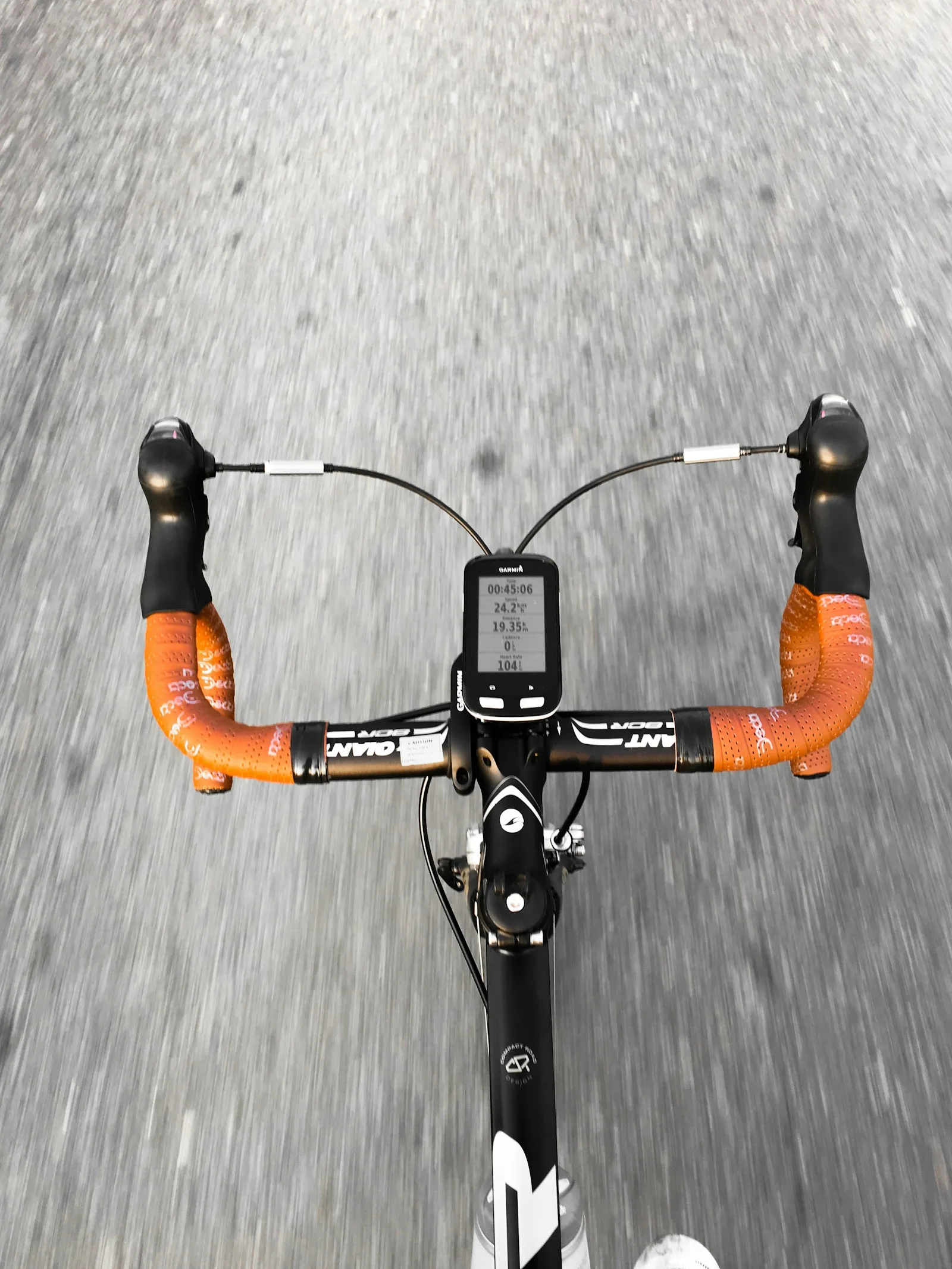
Almost everyone who calls me about a trip asks how fast we ride, and most of them ask twice. Most of them also want to know something else: is my speed good enough? So what's a good average speed on a road bike?
Here's the problem with the number on your bike computer. It doesn't tell you three things. Were you alone or in a group? Was the road flat or hilly? And did your computer divide by the time you were rolling, or by the whole ride including the coffee stop? Change any one of those and the same rider gets a different number on the same day.
The short answer
In a group on rolling roads, 15 to 16 mph is a steady ride, 17 to 18 mph is a fit club ride, and 19 mph and up is a fast one. Those are the speeds most bike clubs use to describe their group rides.
Riding alone, take about 2 to 3 mph off each of those. That puts a steady solo ride at about 13 mph, a fit one at about 15 mph, and a fast one at 17 mph and up, all as moving averages on rolling roads.
If your solo average on your usual loop is 15 mph or better, you're a fit rider. That's a good average speed on a road bike, and it's enough to hold a steady group pace.
Why your solo speed and your group speed aren't the same number
Riding alone, you push all the air yourself. In a group, you don't.
Tucked in behind one other rider, you need roughly 30% less power to hold the same speed. Lab and wind tunnel studies put it anywhere from about 30% to nearly 40%, depending on how fast you're going and how close you sit. A whole group shares that work, because everybody takes turns at the front.
What does that do to your average? Riders who have measured their own solo and group rides on the same roads report the group running 2 to 3 mph faster for the same effort, and sometimes more on a flat road. That's where the 2 to 3 mph in the short answer comes from.
There are two places where it stops helping:
- At slow speeds, the air isn't pushing back hard enough for the draft to save much.
- On a climb, gravity is doing most of the work against you, so the draft almost disappears. A group climbs at about the speed of the people in it.
So don't compare your solo Saturday loop with someone's Thursday night group ride. They're different numbers.
What the A, B and C labels on a club ride mean
Most bike clubs sort their group rides by letter. A common version looks like this:
- A ride: 19 to 20 mph and up
- B ride: 17 to 18 mph
- C ride: 15 to 16 mph
That's a common version, not a standard one. One club's B ride is 15 to 19 mph. Another's C ride is 10 to 14. A letter tells you how a ride compares with the other rides at that club, and nothing about how it compares with yours. So don't ask which letter a ride is. Ask what speed it holds, on what roads.
You'll also see no-drop on a ride listing. It means nobody gets left behind: if you flat, fall off the pace or need a stop, somebody waits with you. At a lot of clubs the slower rides are no-drop by default and the faster ones aren't, unless the listing says so.
How hills and wind lower your average speed
On a flat road at around 20 mph, air resistance is most of what you're pushing against, somewhere between 70% and 90% of it. And the power it takes to push that air rises much faster than your speed does. Going from 16 to 18 mph is 12% faster, and it takes about 42% more power against the air. That's why the last mile per hour on your average is so much harder to add than the first one.
Hills lower your average more than most riders expect. Say you climb 10 miles at 8 mph and descend the same 10 miles at 30 mph. Isn't that an average of 19 mph? It's not. The climb takes 75 minutes and the descent takes 20. That's 20 miles in 95 minutes, which is an average of about 12.6 mph. You spend most of the ride going slowly, so the slow part counts for most of the average.
Wind works the same way. Riding out into the wind and coming back with it behind you doesn't cancel out, for the same reason: you spend longer on the slow half, into the wind.
So a lower average on a hilly ride doesn't mean you rode worse than on a flat one. When you compare your speed with anyone else's, compare it on the same kind of road. There's more on getting ready for climbing in how to train for hilly bike rides.
Moving average and elapsed average are two different numbers
Strava shows a moving average by default, and so does a bike computer with auto pause turned on. It only counts the time the wheels were turning, so stops at lights, cafes and the top of a climb don't count against it.
Elapsed average divides by the whole ride, start to finish. Take a 60-mile day with four hours of riding at 15 mph and an hour of stops. The moving average is 15 mph. The elapsed average is 12 mph.
When a club or a trip states a pace, it means the speed while you're riding, not the day including the stops. So compare your moving average with it.
How to find out your real average speed
Don't trust your best day. Trust a normal one.
- Pick a loop you know. Thirty to 40 miles of the kind of road you ride most weeks.
- Ride it alone at a pace you could hold all day. Not a time trial. You should be able to talk in full sentences.
- Write down the moving average. Do it on two different days, so one day with the wind behind you doesn't give you a number that's too high.
- Then ride your club's group ride and write that number down too. The difference between the two is how much the group adds to your speed.
Now you have two real numbers instead of a guess. Those are the numbers you compare with any group ride or trip that states a pace.
Is 16 mph fast on a bike?
It depends on whether you're alone, so here are both answers.
Alone, on rolling roads, 16 mph moving is a fit pace. It's about what a rider who holds a 17 to 18 mph club ride averages on their own.
In a group, 16 mph on rolling roads is a steady pace. Fit riders hold it all day and still talk. If you average 13 to 14 mph alone, the 2 to 3 mph the draft is worth puts you at about 16 in a group.
The same reasoning answers the other numbers people ask about. Is 15 mph fast on a bike? Alone, it's a fit average. In a group, it's a steady one. Is 18 mph fast on a bike? Alone on rolling roads, it's fast. In a group, it's a fit club ride.
What pace to look for on a group bike tour
On a guided tour, the pace matters more than almost anything else on the page. You'll ride with the same people all day, every day of the trip. If the group is faster than you, it's a hard week. If it's slower, it's a long one.
Ask four things before you book:
- What speed does the group ride, and on what roads? A number in mph, not "moderate" or "all abilities".
- Is it one group, or does it split?
- What happens on the climbs?
- Does the support vehicle stay with the group?
Here's how we answer it. Our trips aren't built for beginners, and they aren't built for the fastest riders either. They're built for the rider in the middle. One route a day, one group, one pace: about 16 mph on rolling roads, riding together, and the support vehicle stays with the group. If you can hold that in a group on your home roads, the trip is built for you. Slower than that and the day stops working, for you and for everyone else, because there's one van and it stays with the group.
Faster than that? You're welcome, and you're free to ride ahead. We regroup at the stops, and between them you're on your own.
On the big climb days there's no group pace. Everyone climbs at their own speed, the van moves front to back checking on everyone, and we regroup at the lookouts.
Whatever we're running right now is on the trips page.
The whole thing in five lines
- In a group on rolling roads, 15 to 16 mph is steady, 17 to 18 mph is a fit club ride and 19 mph and up is fast.
- Alone, take 2 to 3 mph off each of those, because you're pushing all the air yourself.
- Hills and riding into the wind lower your average more than they look like they should, because you spend longer on the slow part.
- Compare moving average with moving average, on the same kind of road.
- Ride your own loop alone twice and your club ride once, and you'll know exactly where you fit.
If the pace is right, the rest of a trip is about how many days in a row you can ride it. That part is in how to train for a multi-day cycling tour.