
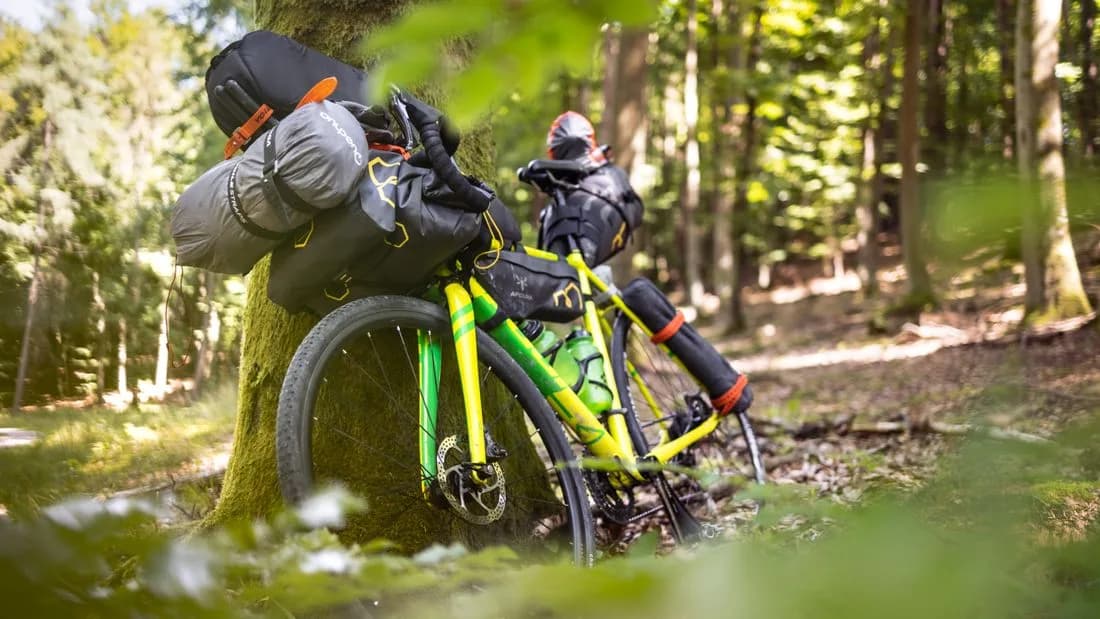
People use these two words as if they mean the same thing. They don't, and the difference isn't small.
Bike touring is riding from place to place with your gear carried on racks, mostly on paved roads. Bikepacking is the same idea taken onto dirt, with the gear strapped straight to the frame and no racks anywhere on the bike. Racks or no racks sounds like a detail about luggage. It isn't. It decides which bike you ride, how far you get in a day, where you sleep, and what the whole thing costs you.
I do neither one. I run guided road trips and I ride every mile of them with the group, so nobody on my trips carries luggage on a bike at all. But riders ask me about this constantly, because they're trying to work out which version of a bike trip they actually want. Most of what's written about it skips the parts that decide it.
So here's what each one is, where they really differ, and how to tell which one you've been picturing.
The short answer
Bike touring is pavement, metal racks, panniers, longer days and a heavier bike. Bikepacking is dirt, soft bags strapped to the frame, shorter days and a lot less stuff.
If the picture in your head is a quiet paved back road, a town to stop in that night and a hot meal you didn't cook, you're thinking about touring. If it's a forest road, a tent, and no shop for two days, that's bikepacking. Both are real. Neither one is the advanced version of the other.
What bike touring is
Touring is the older of the two, and it's the one most people can already picture. You ride a bike built to carry weight, on roads that cars also use, from one place to the next. The gear goes into panniers, which are bags that hang off metal racks over the wheels. A full setup is four of them, two low at the front and two at the back, with a tent or a sleeping bag strapped across the rear rack on top.
A touring bike is built for exactly that. It has threaded eyelets in the frame and fork so racks bolt on solidly. The wheelbase is long, so your heels clear the rear panniers when you pedal. The gearing goes lower than a road bike's, because a loaded bike on a climb is a different machine. The tires are wider than a road bike's, plenty of the frames are steel, and most have drop bars. None of that is about speed. It's all about carrying weight without the bike getting unpleasant.
There are two versions of touring, and they're not close to each other.
Loaded touring means you carry everything, including a tent, a sleeping bag, a stove and food. You're self sufficient and you can stop anywhere.
Credit card touring means you carry clothes, tools and a rain jacket, and you sleep indoors every night. Two rear panniers is plenty, and the bike stays light enough to still feel like a bike.
Credit card touring is what most riders who try touring end up doing, and a lot of people don't know it has a name. If you like riding all day and you don't want to cook dinner in a car park, that's the one you're looking for.
What bikepacking is
Bikepacking is the newer word. It grew out of long unsupported races on dirt, where riders needed the gear off racks entirely. Racks rattle themselves apart on rough ground, and panniers stick out wide, which is a problem on a trail with trees and rocks either side of you.
So the bags got strapped to the bike instead. There are three main ones. A roll goes across the handlebars, a wedge fills the triangle inside the frame, and a large pack straps under the saddle. Add a small bag on the top tube and a couple of bottle sized bags on the stem and that's the whole system. All of it is soft, all of it straps on, and none of it needs a bolt or a bracket.
That has a real consequence: almost any bike works as a bikepacking bike. A mountain bike, a gravel bike, an old hardtail in your garage, even a road bike for a single night out. You don't need eyelets, so you don't need a bike built for this.
The other consequence is that you carry less, because there's less room. That's the design rather than a sacrifice. Bikepacking makes you decide what not to bring, and riders who do it a lot will tell you that's the part they like.
Panniers or strap-on bags
The bike matters less than the way the bags attach.
Panniers hold more, and they hold it in a way you can get at. You unclip a bag, carry it into a room, and clip it back on in the morning. The weight sits low and over the wheels, which keeps the bike steady. In exchange, they hang out wide, they need a bike with eyelets, and every rack bolt on the bike wants checking.
Bikepacking bags hold less and take longer to pack, because a seat pack loads from one end and whatever you need is at the bottom of it. In exchange the bike stays narrow, nothing rattles loose, and the same set of bags moves onto whatever bike you own.
Neither one is better. They solve different problems, and the problem they're solving is the road you're going to ride.
How far do you actually ride in a day?
This surprises people more than anything else on the list.
On pavement, with a loaded touring bike and a rider in ordinary shape, fifty to seventy miles is a normal day. That's six or seven hours of riding once you count stops, and you can hold it day after day.
Take the same rider and the same effort onto gravel and forest road with a bikepacking load, and the day is thirty to fifty miles. Loose surfaces are slower, climbs are steeper because dirt roads weren't graded for cars, and you stop more. There's also no shop when you want one, so you're carrying water and food you'd otherwise buy.
Neither number says anything about fitness. They're about surface and weight. A rider who covers ninety miles on a road bike at home will not cover ninety on a loaded bike on dirt, and being surprised by that on day one is how a trip turns bad.
Where you sleep decides most of it
Here's the question that sorts this out faster than any gear list: do you want to carry a place to sleep?
If you carry a tent, a mat, a bag and a stove, everything else follows. The load doubles, the bike needs to handle it, the days get shorter and the route has to include water. If you don't carry any of it, the load halves and the route has to include towns with rooms in them, booked ahead or found when you get there.
That's the decision, and neither word settles it. There are bikepackers who sleep in motels and tourers who camp every night. Deciding where you're sleeping first, then buying bags to match, is the right order. Most people do it backwards.
What each one costs to get into
I'm not going to put numbers on gear, because they'd be wrong within a year. Where the money goes is the useful part, and it goes to different places for the two.
Touring puts the cost in the bike. Racks bolt to eyelets, and most road bikes and a lot of gravel bikes don't have them, so you're either buying a touring bike or fitting a workaround you won't love. Then you buy racks and panniers on top of the bike.
Bikepacking puts the cost in the bags. You strap them to the bike you already own, and if you decide it isn't for you, the bags fit the next bike too.
The cost after that runs the other way. Camping most nights is cheap, and a room every night for a week isn't. Over a few trips, that gap gets bigger than the gear ever was.
The third option, which is neither
There's a version of a multi day bike trip where you carry nothing at all, and it doesn't have a good name, so it gets left out of the comparison.
On a supported or guided trip, you ride an unloaded bike, your bags get moved to the next hotel, and the room is already booked. Backroads, Trek Travel and DuVine all sell that version, at the expensive end of it. Smaller companies sell it too, mine included, and you can find riders who arrange it privately with a friend driving. What every one of them has in common is that the bike stays light and the logistics stop being yours.
It's a completely different day on the bike. You ride the way you ride at home, fast if you want, with nothing on the frame. What you give up is the freedom to stop where you like and change the plan on a Tuesday afternoon. Plenty of riders who love touring don't want that trade at all, and they're not wrong. Our trips show how a route and the nights get put together.
Which one are you actually asking about?
Three questions, and they answer it fast.
What surface do you want under you? Pavement points at touring. Dirt and gravel point at bikepacking. If you'd rather not think about tires at all, you want pavement.
Do you want to carry a bed? A tent means camping gear, which means racks or a big seat pack and shorter days. A room means far less to carry either way.
How much do you want to plan? You can plan a paved route with towns on it the night before. A dirt route with two hundred miles between shops has to be planned properly, because getting the water wrong out there is a genuine problem rather than an inconvenience.
What to look up before you commit to either
A few things are faster to check yourself than to ask anybody, and they'll change your answer.
Look at the surface of the route you're dreaming about, on a satellite map, not a description. A lot of routes sold as gravel are pavement with a dirt section, and a lot of routes sold as quiet are two lane roads with trucks on them.
Look at the gaps between towns. That single number, the longest stretch with nothing on it, decides how much water and food you carry, and it decides whether you need to camp at all.
Look at the typical weather for that place in the week you're going, not the month. It'll change what you pack more than any advice will, and it takes about two minutes.
Then pick the one you actually pictured at the start. If it was a hot meal in a town, don't buy a tent. If it was a fire and nobody around, don't buy panniers. And if it was a fast day on a light bike with none of the admin, that's the third one, and there's nothing wrong with wanting it.
If packing is where you're stuck next, what to pack for a multi day ride covers the list that doesn't change no matter which of these you pick.