
Two questions hide inside this one. The first is what you eat while you are riding. The second is what you eat for the rest of the day, so that tomorrow is any good.
On a tour you are back on the bike in about sixteen hours, and then you do it again, and again. A shortfall you create on day one does not clear itself overnight, and by day four it is the reason your legs feel like they belong to someone else.
I run the trips I sell and I ride every one of them, which means I have eaten my own itineraries, including the day with 8,270 feet of climbing in it. Here are the numbers I use, the research they come from, and what they look like as food you can actually get down.
The short answer
- On a riding day under two and a half hours: 30 to 60 grams of carbohydrate an hour while you ride.
- On a riding day over two and a half hours: 60 to 90 grams an hour, from mixed sources.
- Before the ride: 1 to 4 grams of carbohydrate per kilogram of body weight, eaten 1 to 4 hours out.
- After the ride, when you ride again tomorrow: 1 to 1.2 grams per kilogram per hour for the first four hours, plus 20 to 40 grams of protein.
- Across the whole day: 6 to 10 grams per kilogram on a normal riding day, 8 to 12 on a big one.
Those per-kilogram figures are the joint position stand of the Academy of Nutrition and Dietetics, Dietitians of Canada and the American College of Sports Medicine. They are the same numbers stage racers work from, and stage racing is the closest sport to what a tour asks of you: ride hard, sleep, do it again.
Put a real rider in them. A 165 pound rider is 75 kilograms, so:
- A normal riding day: 450 to 750 grams of carbohydrate.
- A day like our Mount Lemmon ride: 600 to 900 grams.
- Breakfast on its own: 75 to 300 grams, depending on how close to the rollout you eat.
- The first four hours after a hard day: 75 to 90 grams an hour, which is 300 to 360 grams before dinner is even served.
Those totals are much larger than what most riders eat on a tour, and that gap is the whole subject.
Turning grams into food you can carry
Grams an hour means nothing until you know what a gram looks like. Rough numbers, off the labels:
- An energy gel: about 22 grams of carbohydrate, 100 calories.
- A medium banana: about 27 grams.
- A standard Clif Bar: 45 grams, 250 calories.
- A 500 ml bottle mixed to 160 calories: 40 grams.
- A 500 ml bottle mixed to 320 calories: 80 grams.
- A bottle of one of the newer super high carb mixes: about 100 grams.
Now do the arithmetic on the biggest day of our Tucson week. Mount Lemmon is 89 miles with 8,270 feet of climbing, and for most riders it is about six hours of pedaling. At 70 grams an hour that is 420 grams of carbohydrate while you are on the bike. In gels alone, that is nineteen of them. Nobody eats nineteen gels, and anyone who tried would spend the descent regretting it.
Which is why the answer on a long day is mostly liquid. Three shapes that work:
- One 320 calorie bottle an hour, plus plain water for thirst: 80 grams an hour with nothing to chew.
- One 160 calorie bottle an hour plus a gel every thirty minutes: about 84 grams an hour.
- Real food at the rest stops, a gel before each climb, and a bottle of mix between them.
Pick one and practice it. A bottle carrying 80 grams of carbohydrate is a lot of sugar going through your stomach at once, and the first time you find out whether you tolerate it should not be at mile 60 of a century.
Breakfast is the meal that gets shorted
The most common fueling mistake on a tour is not made on the bike. It is made at the breakfast table, by a rider who has coffee, half a plate, and a long conversation.
You slept eight hours without eating, so your liver glycogen is down before you start. Research on riders who eat a low carbohydrate breakfast shows the day's performance suffers even when lunch is fine. Eat 1 to 4 grams per kilogram of body weight, and give yourself two to three hours before the rollout if the schedule allows it. If it does not, eat what you comfortably can 60 to 90 minutes out and carry the rest in a jersey pocket.
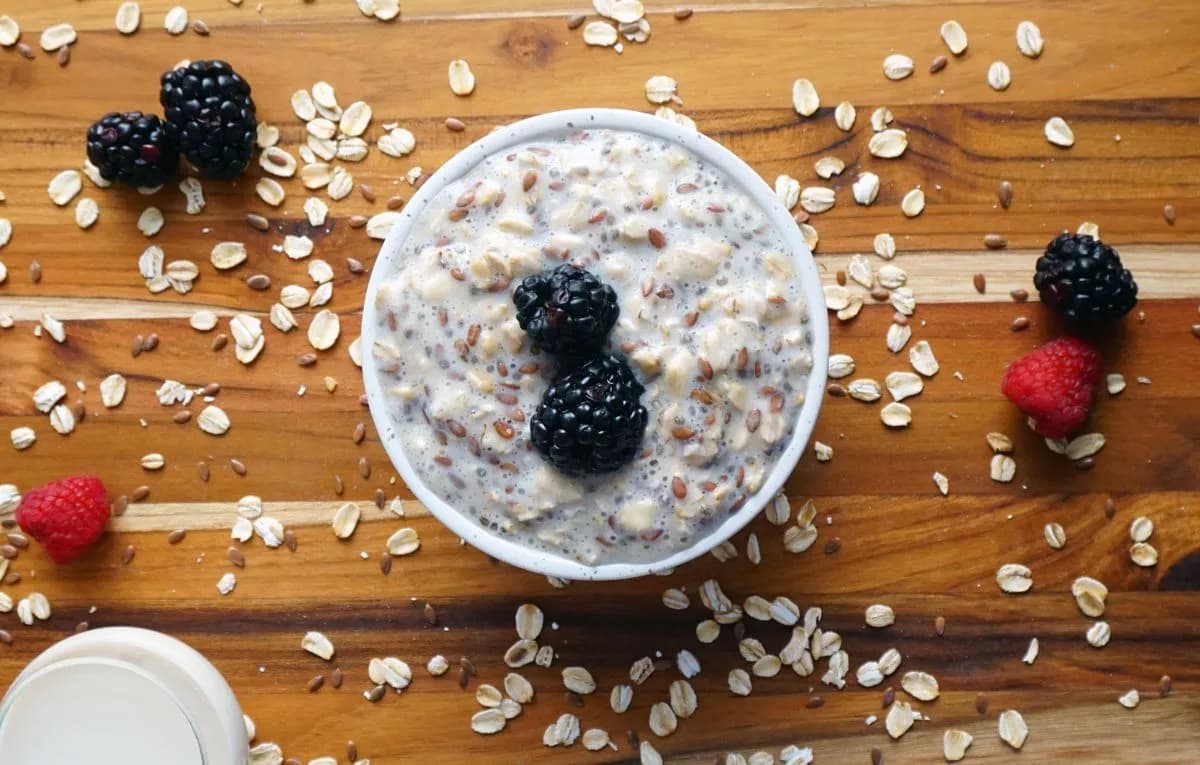
What 120 grams of carbohydrate looks like on a hotel breakfast: a cup of oatmeal, two slices of toast with jam, a banana and a yogurt. Add eggs for the protein. Go light on fat and fiber compared with your normal breakfast, because both slow everything down, and do not eat anything you have never eaten before a ride.
Eating while you ride
- Start eating in the first 30 minutes, before you feel like you need it.
- Eat on a clock, not on hunger. Every 20 to 30 minutes, whether or not you want it.
- Eat before a climb, and drink through it. Hands and breathing are both busy on a steep grade.
- Plan to eat nothing on a long descent, because you will not. Off the top of Mount Lemmon it is 15 to 20 degrees cooler than the valley and both hands are on the brakes.
- Take a real bite at every stop. A rest stop is 90 seconds of chewing you will not have to do at 15 mph.
The reason to eat before you are hungry is that hunger arrives late. By the time it turns up you are already behind, and you cannot absorb fast enough to catch up while riding hard. Every rider who has bonked on day three describes the same thing: they felt fine, and then they did not.
Drinking, and the salt nobody counts
Sweat rates among trained cyclists run from 0.4 liters an hour to over 2.0, and go higher in real heat. That is a fivefold spread, which is why every one-size rule about how much to drink is wrong for most of the people reading it.
Find your own number. Weigh yourself before and after an hour of riding without drinking, and every kilogram you lost is about a liter of sweat. Do it once in cool weather and once in heat and you will know more than most riders you ride with.
Sodium is the part people skip. Cyclists lose somewhere between 200 and 2,000 milligrams of sodium per liter of sweat, another enormous individual range, and the American College of Sports Medicine puts replacement at 300 to 600 milligrams an hour, or 500 to 700 milligrams per liter of fluid. On a hot day, plain water alone is how you end up with a headache at dinner and cramp on the second climb.
Dry heat is the version that catches people out. Tucson in early April is highs in the low 80s with almost no humidity, so your sweat evaporates before you notice it and nothing about you feels wet. You are still losing it. When you get off, replace 1 to 1.5 liters for every kilogram you are down.
The hour after you stop
This is the hour that decides day four, and on a tour it is worth more than anything you do at dinner.
When your next ride is less than eight hours away, take 1 to 1.2 grams of carbohydrate per kilogram per hour for the first four hours, and put 20 to 40 grams of protein in the first serving. The protein is not optional filler. Adding it lets you reach the same glycogen result on roughly 0.9 grams of carbohydrate per kilogram per hour instead of 1.2, and it starts the muscle repair the carbohydrate cannot do.
For a 75 kilogram rider that first hour is 75 to 90 grams of carbohydrate. A bottle of recovery mix, a Coke and a sandwich covers it. That is what the cold drinks and food waiting at the finish of each of our days are actually for, and I would rather you drank one before you shower than after.
Across the whole day, endurance riders need 1.2 to 1.8 grams of protein per kilogram, so 90 to 135 grams for that same rider, spread across meals at about 0.3 grams per kilogram each rather than loaded into dinner.
Dinner, and the beer question
One beer at dinner is not what ruins day four.
Alcohol straight after a long ride does have a modest slowing effect on glycogen restocking, and studies of heavy drinking show it blunts muscle repair. Measured across a full 24 hours, though, the glycogen effect largely washes out as long as you still eat the carbohydrate. The real damage from a big night on a tour is displacement: the beer takes the place of the food, it takes the place of the water, and it takes the sleep that was doing the rest of the work.
So eat dinner first, drink second, and treat the last night differently from the night before the century.
What day four is telling you
Riders describe day four in the same words every time. Fine on day two, hollow on day four. Legs heavy in the first 20 minutes. Heart rate that will not come up, and no interest in breakfast.
That is almost never fitness. Fitness does not disappear in 72 hours. It is the accumulated shortfall from three days of eating like a person who rode once, and the way to fix it is on days one, two and three, not on day four. This is also why training for consecutive days matters as much as the fueling does, which I wrote about in how to train for a multi-day cycling tour.
What a guided trip changes, and what it does not
On a supported trip the logistics of food stop being your problem. On our Fredericksburg Hill Country trip there is a hot breakfast every morning, mid-ride snacks, hydration, electrolytes and fuel out on the road, lunch on the century day, and cold drinks waiting at the finish of every ride. On our Tucson week every meal is included, breakfast, lunch and dinner, plus the on-bike nutrition, with a support vehicle on the route and a mechanic riding with the group.
Four things stay yours no matter who is carrying the cooler:
- Your gut. Nobody can train it for you, and tolerance for 90 grams an hour is built over weeks of long rides.
- Your products. Bring the gels and the mix you already know, in the flavors you can still stand on day three.
- Your caffeine. If you use it, 3 to 6 milligrams per kilogram about an hour before is the usual dose, and a tour is not the week to double it.
- Your dietary needs. Tell the operator early. Celiac, vegan, an allergy or a gut that hates fructose are all easy to plan around in advance and awkward to solve in a small-town restaurant at 8pm.
The mistakes I see most
- Starting the day on coffee and half a plate.
- Waiting to feel hungry before opening anything.
- Riding a hot day on plain water.
- Trying a new gel or a new mix on the biggest ride of the week.
- Carrying nothing on the bike because the support vehicle has everything, when the vehicle is not next to you on a climb.
- Eating a small dinner because the day felt easy.
The honest summary
Eat 60 to 90 grams of carbohydrate an hour on the long days, mostly through a bottle. Eat a real breakfast. Eat again within the hour after you stop, before you shower. Drink to your own sweat rate and put salt in it. Then eat a full dinner, sleep, and do it all again.
None of that is exotic and none of it is expensive. It is just relentless, and on a multi-day trip it is the difference between a last day you enjoy and a last day you survive.