
Ask ten American cyclists where the best riding in the country is and you will get ten different answers, and most of them will be right. "Best" is not one place. It depends on what you want out of a week off the bike path: a climb you will still be talking about in ten years, roads where a car passes you once an hour, or a view at the top that makes the whole day worth it.
I run Velo Escapes and I ride every trip we put on, so I have spent a lot of time riding and researching this question instead of reading brochures about it. Here is the honest version, region by region, with the tradeoffs nobody puts in the marketing copy.
Start with the week, not the map
Before you compare destinations, answer four questions about yourself. They will cut the list down fast.
- How much climbing do you want in a day? There is a large gap between 1,500 feet and 8,000 feet, and it is the difference between a good week and a miserable one.
- When can you actually go? Half the great American riding has a narrow season. Arizona is superb in February and dangerous in July. Montana barely exists as a cycling destination before June.
- How do you feel about altitude? Colorado's best roads sit above 11,000 feet. If you live at sea level, that is a real physiological problem, not a detail.
- Do you want support? Carrying your own gear and booking your own beds is a different sport from riding a light bike while someone else moves the luggage and fixes the flat.
The regions worth flying for
Southern Arizona, for winter
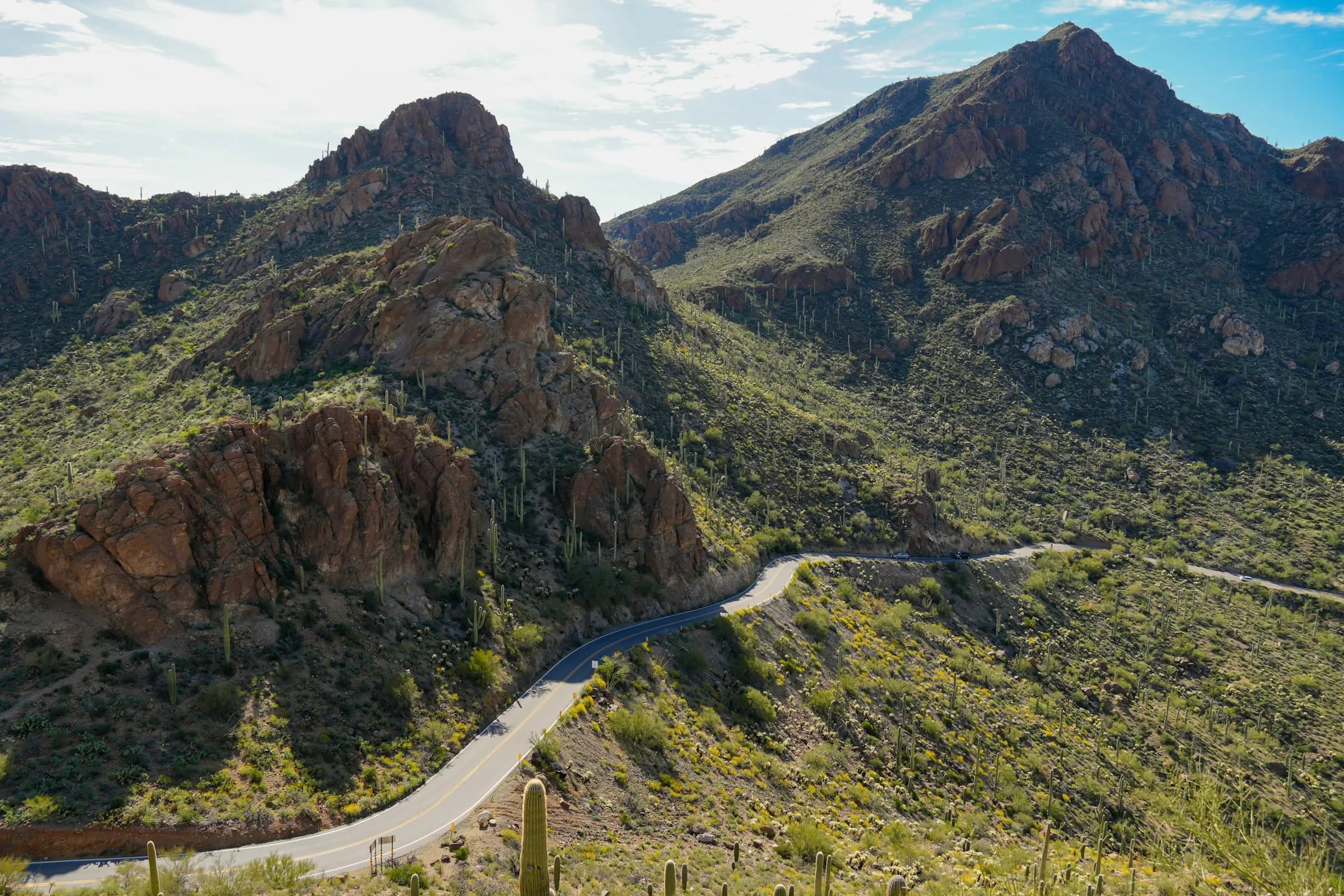
Tucson is the best cold-weather road cycling in the United States, and Mount Lemmon is the reason. The Catalina Highway climbs roughly 27 miles from the valley floor and gains over 6,000 feet at an average grade of about 4.7%, which means it is long rather than steep. You start among saguaro cactus in the desert and finish in pine forest near 9,000 feet, watching the vegetation change under your wheels. The full out and back runs about 60 miles.
It is one of the great climbs in North America, the pros train on it, and in January it is 65 degrees at the bottom. The catch is summer: from June through August, riding in southern Arizona is a heat management exercise, not a vacation.
Go: November through April.
Texas Hill Country, for rolling roads and wildflowers
An hour or two northwest of San Antonio the land folds up into limestone hills, and the ranch roads through them are some of the most underrated cycling in the country. The famous set is the Twisted Sisters, a roughly 100 mile loop linking Ranch Roads 335, 336 and 337, full of short sharp climbs, river crossings and switchbacks that most people do not expect from Texas. Further north, the Willow City Loop turns into a wildflower corridor in spring when the bluebonnets come out.
The terrain suits a real riding week without wrecking you: 50 to 80 mile days with 1,500 to 3,000 feet of climbing, which is enough to feel earned and repeatable four days running. Traffic is light, the towns are close together, and the barbecue is a legitimate recovery strategy.
Go: March through May, and again in October.
The Blue Ridge Parkway, for the long ridgeline
469 miles of park road running from Shenandoah National Park in Virginia to Great Smoky Mountains National Park in North Carolina, built for the view rather than for getting anywhere. The high point is Richland Balsam at 6,053 feet. Riding its full length is a genuine multi-week undertaking, so most people take a section of it, usually the North Carolina end where the climbing is biggest.
Be honest with yourself about fitness here. There are no bike lanes, the shoulders are thin or missing, and the tunnels are dark. This is a road for confident, strong riders, and the climbing adds up faster than the mileage suggests.
Go: late May through October.
The Natchez Trace Parkway, for a first big trip
If you want a long multi-day ride without the sharp end of the difficulty, this is the one. The Trace runs 444 miles from Natchez, Mississippi to Nashville, Tennessee, and the National Park Service has designated the entire length a bicycle route. Commercial traffic is banned outright. There are no stop signs and no traffic lights. The speed limit is 50 mph, and restrooms turn up every 20 to 30 miles.
The result is closer to a 444 mile bike path than a highway. The riding is gentle and green rather than dramatic, which is exactly the point: it is the most forgiving long tour in America and the one I would send a first-timer on.
Go: April to May, or September to October. Summer in Mississippi is humid enough to be its own opponent.
Glacier National Park, for the ride you cannot book
Going-to-the-Sun Road in Montana climbs through some of the most spectacular terrain in the country, and for a few weeks each spring it belongs to cyclists. Once the plows go in, the alpine section stays closed to cars while people on bikes are allowed up it. That window usually runs from around Mother's Day until Logan Pass opens to traffic, which averages mid-June but has happened as late as mid-July in a heavy snow year and as early as late May in a light one.
Nothing else on this list compares to riding a car-free alpine pass. It also carries by far the most timing risk, since the window moves with the snowpack, sections close Monday to Thursday while crews are plowing, and you cannot know your dates a year out. Plan it as an opportunity, not as a guarantee.
Go: mid-May to mid-June, with flexible plans.
Colorado, for the altitude test
Trail Ridge Road tops out at 12,183 feet in Rocky Mountain National Park and is the highest continuous paved road in the United States. As a climb it is among the longest in the country. The scenery above treeline does not really have an American rival.
The altitude is the whole story. If you live near sea level and fly in on Friday to ride at 12,000 feet on Saturday, you will have a bad time no matter how fit you are. Build in acclimatization days, ride the first ones easy, and drink far more than feels necessary. Anyone with a heart or lung condition should talk to a doctor before booking, not after arriving.
Go: late June through September. The road is seasonal and usually closes by mid-October.
Vermont, for short days with brutal numbers
New England's mountains are small and the roads over them are not. Lincoln Gap is widely described as the steepest paved mile in the United States, averaging around 15% with pitches near 24%. The other Green Mountain gaps are only slightly kinder. A 60 mile day here can hurt more than a 100 mile day elsewhere.
Add fall foliage and you get a week that photographs better than almost anything else in the country. Bring low gearing. Whatever you think is low enough, go lower.
Go: July through early October.
So which one is actually best for you?
- First long trip, want to finish smiling: the Natchez Trace Parkway, or the Texas Hill Country.
- You want one legendary climb in the bank: Mount Lemmon in Tucson.
- You want to be genuinely tested: the Blue Ridge Parkway, or the Vermont gaps.
- You want a day nobody else gets: the spring window on Going-to-the-Sun Road.
- You want scenery above treeline and you respect altitude: Trail Ridge Road in Colorado.
- You can only travel in winter: southern Arizona, and it is not close.
What separates a great tour from an expensive one
Once you have a region, the operator matters more than the brochure photos. Four things tell you most of what you need to know.
Does the person leading it actually ride with you? A guide in a van is running logistics. A guide on a bike knows which climb is worth it, which descent is sketchy at 4pm when the light goes flat, and when you are having a bad day before you say so.
How many riders are in the group? Small groups can ride at a real pace and eat somewhere that is not a banquet hall. Big groups get split into ability bands and moved on a schedule.
What is included, in writing? Lodging, meals, on-road support, and route navigation should be spelled out. Compare the total cost per day, not the headline price, and ask what happens with flights, bike rental and tips.
What happens if your plans change? You are committing money months ahead. Plenty of operators keep your deposit regardless. Ours stays refundable up to a set date before the trip, because asking someone to gamble a serious deposit a year out is not how I would want to be treated.
We run our own trips in two of these regions, the Texas Hill Country and Tucson, because they are the two places in America where I think a fit rider gets the most out of four days. That is a bias, and I would rather say so than pretend otherwise.
The short version
The best cycling tour in the USA is the one that matches your fitness, your calendar and your appetite for suffering. Southern Arizona for winter. Texas for spring. Natchez Trace if it is your first. Blue Ridge or Vermont if you want to be humbled. Glacier if you get lucky with the snow. Pick the week you actually want, then go find someone who has ridden those roads to run it.